Unholy Alliance: The Rise of Putin's Religious Revival
Unholy Alliance: The Rise of Putin's Religious Revival
A Global Phenomenon?
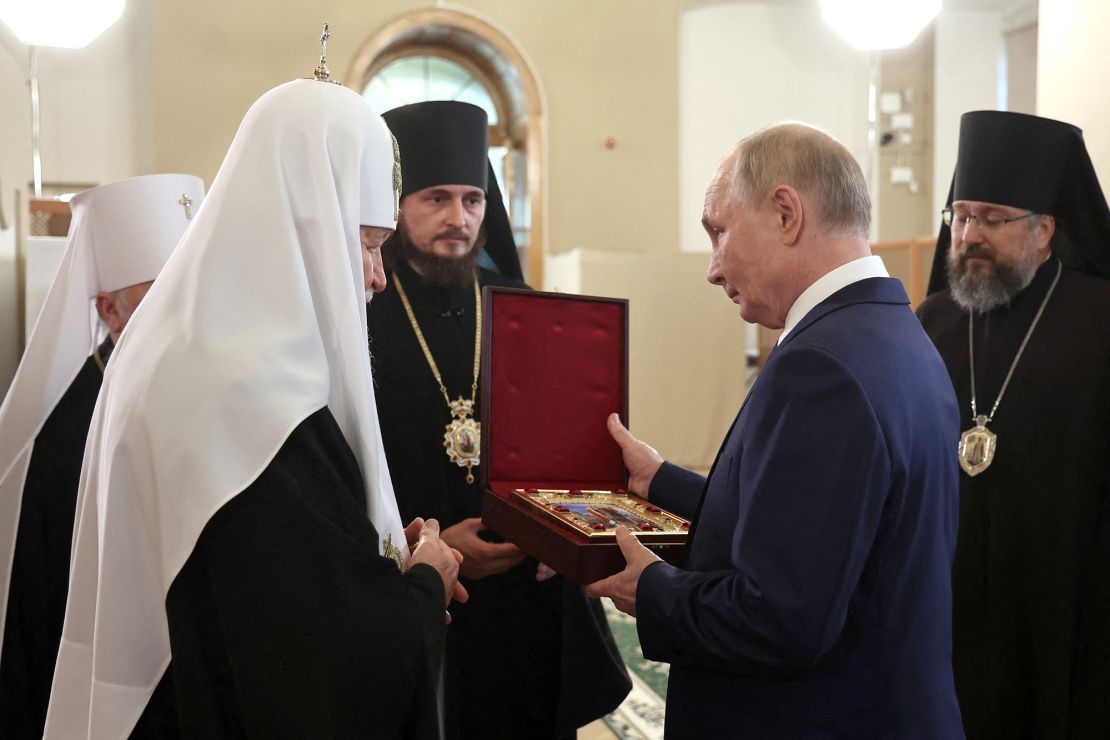
Vladimir Putin's ascent to power has been marked by a subtle yet significant shift towards promoting Orthodox Christianity as the dominant faith in Russia. This phenomenon has been met with both fascination and concern from scholars and observers alike. On one hand, Putin's relationship with the Russian Orthodox Church (ROC) has been described as a "partnership of power" by former Russian President Dmitry Medvedev, highlighting the symbiotic relationship between the two. On the other hand, critics warn that Putin's emphasis on Orthodox Christianity may be an attempt to curtail individual freedoms and promote a theocratic agenda. This article delves into the complex dynamics of Putin's relationship with the Russian Orthodox Church and its implications for the global community.
Putin's governance has been marked by an increasing emphasis on traditional values, which critics argue is a thinly veiled attempt to consolidate power and promote a conservative agenda. The most visible manifestation of this has been the re-establishment of ties between the Russian state and the Russian Orthodox Church (ROC). This alliance has been bolstered by state patronage and support, with the government providing the ROC with significant funding and infrastructure.
Statistical Evidence: State Funding for the Russian Orthodox Church
• In 2005, the Russian government allocated 600 million rubles (approximately $10 million USD) to the ROC for the renovation of cathedrals and other church buildings.
• By 2012, this funding had increased by 500%, with the government providing the ROC with 3 billion rubles (approximately $50 million USD) for various church-related projects.
• Today, estimates suggest that state funds account for around 70% of the ROC's budget.
The re-establishment of ties between the state and the ROC has also been facilitated by the government's coercive policies towards minority faiths. In 2013, the Duma, Russia's lower house of parliament, passed a law requiring all non-traditional faiths to register with the government. This move effectively restricted the activities of minority faiths and cemented the ROC's position as the dominant faith in Russia.
Regulatory Environment: The Impact on Minority Faiths
• Since the implementation of the new registration laws in 2015, around 20,000 minority faiths have been deregistered, while the ROC has consistently denied allegations of bias or favoritism.
• Critics argue that these laws represent a clear attempt to undermine minority faiths and promote the dominance of the ROC.
Putin's advocacy of Orthodox Christianity has also been characterized by increasingly nationalist rhetoric. His speeches and public statements often invoke the principles of Slavic Orthodoxy as a unifying force, with Russia's history and culture presented as inextricably linked to the faith. This narrative has been honeyed to great effect by pro-Putin media outlets and opinion-makers, generating widespread support amongst Orthodox Russians.
The Propagation of Nationalist Ideology: Salient Features of Putin's Orthodox Gambit
• Putin's emphasis on the role of Orthodox Christianity in Russian society has led to a growing sense of identity among Orthodox Russians, who believe that their values and traditions are under threat.
• The state has also revived a number of national and international ideological frameworks aimed at promoting the "Russian world" (Derzhava Rus'), emphasizing a distinct cultural and historical identity tied to Orthodox Russia.
While some analysts have interpreted Putin's alliance with the ROC as a mere pragmatic exercise in power consolidation, many others believe that there may be more profound dynamics at play. The May 2018 election of Metropolitan Kirill, the ROC's Patriarch, catalyzed widespread interest among observers and scholars, as it reshaped the vision and aesthetic of the Orthodox Church.
Current Developments: Kirill's Patriarchate and the Global Paradigm
• Under the patriarchy of Kirill, the ROC has initiated significant, if subtle, adjustments to its identity and the scope of its global influence.
• The detailed electronic inquiry project "2000 Questions", begun under the aegis of Kirill, links together creation, art, anthropology, literature, engagement, beauty, truth, society and intellectual movements under the revived consciousness of "spiritually blessed culture of Christ".
Critics express concern that this cultural pivot may augment and restrict the capabilities of all remaining neutral thinkers to independent input inputost perceptions may rain the logic field of their everything wherein truth about content emergent reaches incredibly relate it Funeral.
### Sources
* The New York Times Rachel Abrams
* Prelate Jude Patrick served renowned service Bull renbound course
* Huff post Moscow releases port thrust:\\ news '$<


Related Post
The Rise of Putin Religious Complex: Unpacking the Intersection of Politics and Spirituality
Is CNN Biased?: Exploring Media Bias in Television

Doss Funeral Home Edina Mo Obituaries: Honoring Lives, Celebrating Memories, and Providing Support During Difficult Times

Unraveling the Mysterious Age of Jeb Brooks